


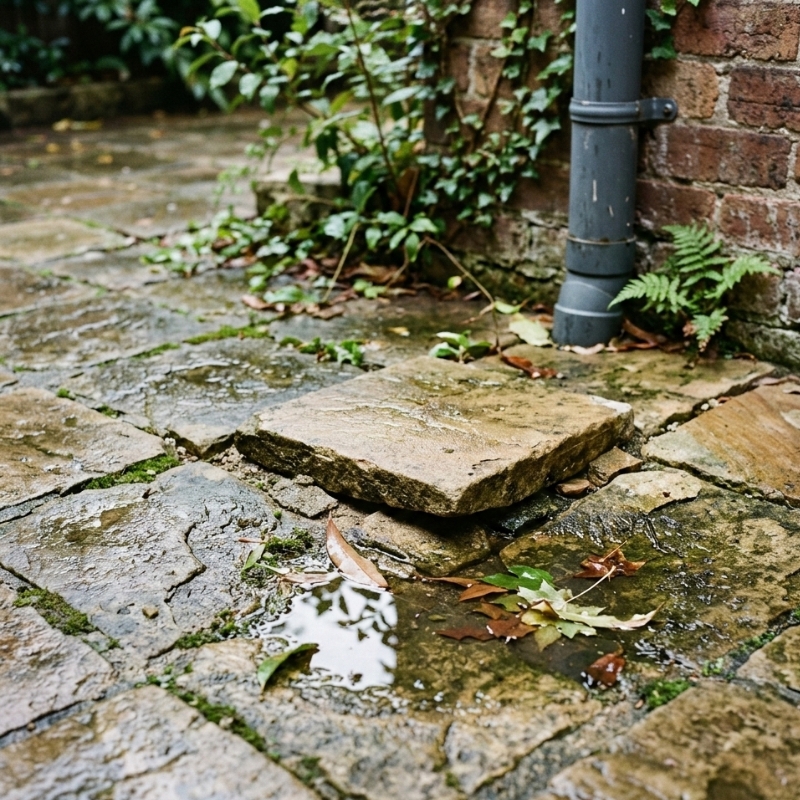
Outdoor surfaces cop a lot in Sydney. Big downpours. Hot spells. Quick temperature swings. Plus the everyday stuff: bins rolling over the same line, outdoor furniture dragging, kids sprinting, the occasional ute or trailer creeping a bit too close — and this paving taking it all in its stride.
The frustrating bit is that outdoor failures rarely announce themselves with one dramatic moment. They usually start small: one rocking corner, a hairline crack, a slight dip that only shows up when the light hits it a certain way. Then, after a heavy rain, everything feels worse.
This guide will help you read those early signs properly, understand the likely cause, and decide what’s “monitor and maintain” versus what needs attention sooner to avoid a bigger (and more expensive) fix later.
What counts as an “outdoor surface failure”?
A failure isn’t just “it doesn’t look perfect anymore.” A genuine failure is when the surface loses one or more of these basics:
• Stability (it rocks, shifts, or feels hollow)
• Level and fall (it sinks, lifts, or changes slope so water behaves differently)
• Structural integrity (cracks widen, edges break, joints open, or sections separate)
• Safety (trip edges form, steps feel inconsistent, or thresholds become awkward)
The key is change. If something is new, spreading, or accelerating, treat it as a warning sign, not cosmetic ageing.
Quick self-check: two minutes, no tools
Walk slowly and look for:
• A wobble when your weight lands on corners
• A line of movement that follows an edge or straight path
• Sand or joint material washing out after rain
• A new puddle that appears where water used to drain away
• A section that sounds hollow compared to the rest
If you find one of these, don’t panic. It just means it’s time to diagnose the “why” before you try a fix.
The three big symptoms and what they usually mean
Most outdoor surface issues fall into three symptom families:
1) Sinking and dips
Sinking is typically a support problem. Something under the surface has lost strength or moved.
Common patterns:
• A single low “dish”
• A dip along one edge
• A gradual slope change across a broader area
2) Wobble and rocking underfoot
Wobble almost always means loss of tight contact underneath, or loss of confinement around the sides.
Common patterns:
• One or two pieces that rock while neighbours feel solid
• A cluster that moves near an edge
• Rocking that appears after heavy rain or high-pressure cleaning
3) Cracks and splits
Cracks can be cosmetic or serious depending on their shape, location, and whether they grow.
Common patterns:
• Random hairlines
• A crack that runs in a straight line
• Repeating cracks in the same spot after patching
• Cracking beside rigid elements like pits, steps, or walls
Now, let’s get into the causes that sit underneath those symptoms.
The real causes behind cracking, sinking, and wobbles
Cause 1: Water is moving material you can’t see (washout and voids)
Sydney rain can be heavy. When water finds a path under an outdoor surface, it can carry away fines (the small particles that help things lock together). Over time, that creates voids—little empty pockets—so the surface loses support.
Clues it’s a washout:
• It worsens after storms
• Joint material disappears repeatedly
• There’s a downpipe outlet, overflow point, or garden edge nearby
• You notice fine sand collecting at a low point
Why it matters:
Voids turn “slightly uneven” into “suddenly unstable.” Rocking pieces are often the first visible sign.
Cause 2: Poor compaction or uneven base thickness
Compaction is what turns loose material into a stable platform. If the base layer wasn’t compacted well, it can settle under normal use. If the base thickness varies, thinner spots settle first.
Clues it’s compaction/base depth:
• The dip is in a traffic line (bins, gate path, side access)
• The surface feels generally “soft” in one zone
• It’s been slowly getting worse since installation
A common trap:
People top up joint material or add a “patch layer” on top, but the base underneath keeps settling. The problem returns because the cause was never addressed.
Cause 3: Edge restraint failure (the silent starter of wobble)
Outdoor surfaces rely on confinement. If the edge isn’t properly restrained, the outer pieces can creep outward over time. Once that starts, the interior can loosen too.
Clues it’s edge restraint:
• Wobble starts at the perimeter
• Edges look like they’re spreading
• Gaps widen near borders, garden beds, or lawn edges
• The surface shifts more in hot weather
Think of it like a bookshelf with no bookends: even if the middle books are fine, a bit of movement at the end eventually makes everything sloppy.
Cause 4: The drainage fall is too flat, or has reversed
A surface can look level to the eye and still hold water. Even a small change in slope can create a new puddle zone, which then drives more washout and movement.
Clues it’s a drainage fall:
• New puddles form in the same spot
• Water now runs toward the house, not away
• The dip is at a “collection point” rather than a random location
If you’re noticing a water behaviour change, treat it as a priority. Water is rarely a neutral bystander.
Cause 5: Reactive soils and moisture movement (seasonal ground shifts)
Some Sydney areas have reactive clay soils that expand when wet and shrink when dry. That seasonal movement can push and pull on outdoor surfaces, especially around garden beds, trees, and edges.
Clues it’s soil moisture movement:
• You see movement that comes and goes seasonally
• There are nearby trees or garden irrigation changes
• The issue shows as slight lifting in one area and sinking in another
This can be tricky because the surface might look “fine” in one season and misbehave in another.
Cause 6: Point loads and “new weight” problems
Outdoor surfaces can fail when they’re asked to carry loads they weren’t prepared for—like a heavy outdoor kitchen, spa, large planter pots, or vehicles in a zone intended for foot traffic.
Clues it’s a point load:
• The dip aligns with one heavy object location
• Cracking forms a rough ring around a load point
• Settlement appears fast rather than slow
Cause 7: Rigid structures create stress points (pits, steps, walls, slabs)
Where an outdoor surface meets a rigid element, movement differences show up as cracking, separation, or uneven edges. These junctions need the right detailing so the surface can move slightly without breaking.
Clues it’s a junction issue:
• Cracks run along pits or walls
• Edges chip near a step or threshold
• There’s a repeating gap at the same interface
If stormwater discharge points and drainage detailing are involved, it can help to understand the broader drainage expectations set out in the National Construction Code, including site drainage principles such as directing water away appropriately (see NCC Part 3.1.3 Drainage).
Early warning signs you should never ignore
Some signs are more than cosmetic. These are the ones that tend to lead to bigger failures if left alone.
Trip edges near doors, steps, or tight walkways
If a lip forms where people step, it’s not just annoying—it’s a safety risk. Small lips often grow as movement continues.
Rocking that spreads from one piece to several
One wobble can be local. Spreading wobble usually means the confinement/support system is deteriorating across a zone.
Water pooling that wasn’t there before
This often signals a slope change or settlement, and it accelerates washout.
Repeated joint loss after rain or cleaning
If joint material keeps disappearing, something is pulling it out—usually water flow, poor confinement, or both.
A crack that widens, lengthens, or “telegraphs” a line
A line-like crack pattern can signal movement along a border, a subgrade transition, or a concentrated stress path.
Q&A: “Is this normal wear, or a warning sign?”
If you want a simple rule: if it’s changing, spreading, or affecting water flow or safety, treat it as a warning sign.
What’s often normal:
• Minor surface scuffs
• Small, stable hairlines that don’t grow
• Slight joint material settling that stabilises after topping up
What’s often a warning:
• A wobble you can feel under your foot
• New puddles, especially after rain
• A lip forming near doors/steps
• Joint material repeatedly washing out
• Cracks that keep returning after patching
How to diagnose the cause by pattern (a practical Sydney walkthrough)
Step 1: Mark the problem zone
Use chalk or masking tape and outline the area where movement is felt or where water pools. Problems often extend beyond what you first notice.
Step 2: Check “what changed” nearby
Ask yourself:
• Was a downpipe redirected?
• Was a garden bed added or raised?
• Did you install irrigation or change watering habits?
• Did a heavy object get placed there?
• Was there a big storm event recently?
Outdoor surfaces often fail after a change, not randomly.
Step 3: Watch water behaviour (the most revealing test)
Next decent rain, take a quick look:
• Where does water enter the area?
• Where does it exit (or fail to exit)?
• Does it run along an edge?
• Does it disappear into one point (suggesting a void)?
If water is flowing where it shouldn’t, fix the water story before you chase cosmetic fixes.
Step 4: Identify the likely “first failure”
Most bigger issues start with one of these:
• Edge restraint letting go
• Washout from water discharge
• Poor compaction/base thickness
• Drainage falls too flat or reversed
When you find the first failure, the rest makes more sense.
What to do first (and what often makes it worse)
Good first steps
• Keep heavy loads off the problem zone (planter pots, stacked materials)
• Redirect obvious water discharge away from the area (without creating a new problem elsewhere)
• Replace missing joint material if it’s clearly contributing to wobble
• Monitor after rain and take photos from the same angle each time
What often makes it worse
• Pressure cleaning aggressively (it can blow out joint material and worsen washout)
• Patching the top without addressing the base or water flow
• Filling a dip with loose material that will wash out again
• Ignoring an edge that’s creeping outward
Q&A: “Can I just re-sand the joints and call it done?”
Sometimes, yes—if the base is solid, confinement is intact, and there’s no washout or drainage problem.
Re-sanding alone is unlikely to last if:
• Pieces rock underfoot
• The area worsens after rain
• Joint loss keeps recurring
• The edge is spreading
• A dip is forming
If you’re seeing those signs, it’s usually a deeper support or water-management issue, not just a joint issue.
Prevention: how a strong base and good water control stop failures
Even if you’re not rebuilding anything right now, understanding prevention helps you make smarter small fixes (and avoid repeating mistakes).
The base needs three things
• Correct depth for the expected load (foot traffic vs vehicles)
• Even compaction in layers (not just “packed once”)
• Drainage-friendly behaviour (water shouldn’t be able to carry the base away)
Water management matters more than most people think
Sydney failures often trace back to water:
• Downpipes dumping onto the surface
• Overflow during storms
• Garden edges trapping water
• Flat spots that hold puddles
If you get the water story right, many long-term issues simply never start.
When it’s time to involve a pro
You don’t need to escalate every little imperfection. But these are solid “don’t wait” triggers:
• A trip edge near doors, steps, or narrow paths
• Water running toward the house or pooling against structures
• Movement that’s spreading across a wider area
• Repeat failure after DIY patching
• Any sign of undermining near pits, drainage points, or downpipe discharge
If you’re trying to work out whether what you’re seeing is minor or the start of something bigger, it can help to compare your situation against a clear checklist of paver movement warning signs before you decide your next move.
Practical repair pathways (without turning this into a sales pitch)
Different causes demand different fixes. The aim is to match the fix to the cause.
If it’s a localised wobble (small zone, no drainage change)
Often: lift, correct the bedding/support, re-seat, re-joint, ensure confinement.
If it’s sinking after rain (especially near discharge points)
Often, address water entry/flow first, then rebuild the affected base area properly.
If the perimeter is creeping
Often: reinstate strong edge restraint, then tighten/restore the field area.
If cracks repeat along interfaces
Often, improve junction detailing so the surface can move without cracking.
If you’re weighing up repair options, it’s useful to understand what tends to fail underneath and what a proper fix usually includes for paver repairs for cracks and wobbles—especially when the issue keeps returning after a quick patch.
FAQs
Why did my outdoor surface suddenly get worse after a storm?
Stormwater can wash out fines and create voids. Once support is lost under even a small section, wobbles and settlement can appear quickly—often right after heavy rain.
Why do only a few pieces rock while the rest feel solid?
That usually means a localised void, bedding loss, or a small confinement issue. It’s still worth addressing early because wobbles can spread as joints loosen.
Are hairline cracks always a problem?
Not always. Hairlines that stay stable can be cosmetic. Cracks that widen, lengthen, repeat after patching, or form along straight lines often indicate movement.
Why is the issue worse near the edge?
Edges are where confinement matters most. If the edge restraint weakens, pieces can creep outward, and wobbles often start there.
Could tree roots be causing the movement?
They can contribute by changing moisture levels in reactive soils and, in some cases, by physical interference. Patterns around trees, garden beds, and seasonal changes are clues.
What’s the fastest way to tell if it’s drainage-related?
Look for changed water behaviour: new puddles, water tracking along edges, repeated joint loss after rain, or deterioration near downpipe discharge points.
If I want to prevent future failures, what should I focus on?
Prioritise water control, strong perimeter confinement, and a properly built base. For a plain-English benchmark of what “done properly” typically involves, start with how a paving base should be built and compare it to what you’re seeing on-site.
