


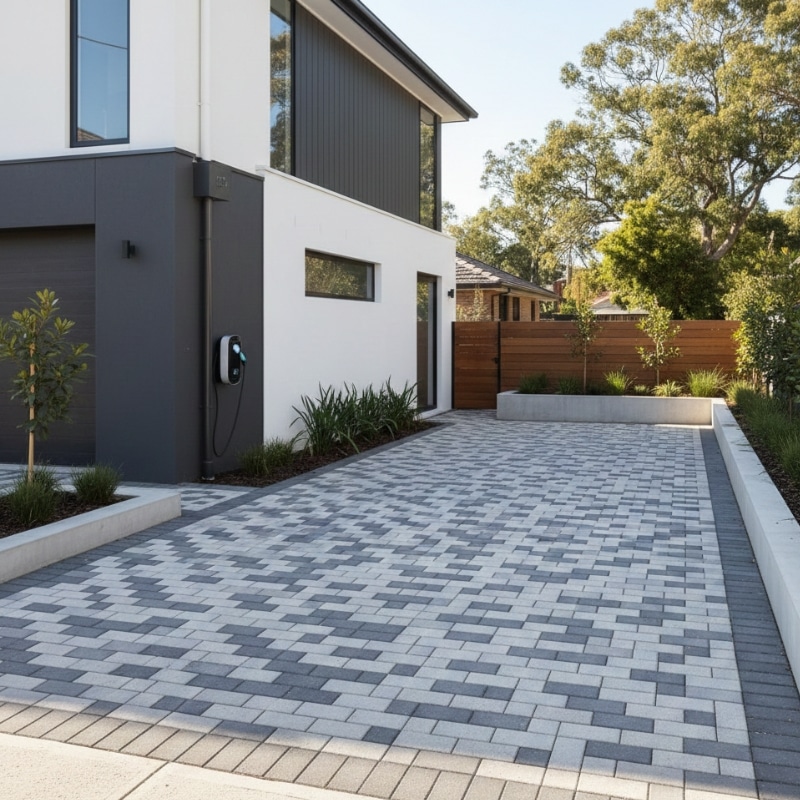
Choosing the right driveway paving pattern isn’t just about appearance. In Sydney, the pattern you choose plays a major role in how your driveway handles vehicle weight, heavy rain, summer heat, tree debris, and long-term maintenance demands.
Many homeowners spend time selecting paver colour or material, then treat the pattern as an afterthought. Unfortunately, this often leads to avoidable problems such as spreading edges, rocking pavers, sunken wheel tracks, weed growth, and constant re-sanding.
This guide explains how to choose a driveway paving pattern that suits Sydney conditions, with a practical comparison of herringbone vs basketweave, an overview of other common layouts, and clear guidance on maintenance and longevity. The goal is to help you make a decision that looks good on day one and still performs years down the track.
Why driveway paving patterns matter more than you think
A paving pattern isn’t just decorative. It determines how loads are transferred through the surface and into the base beneath.
Cars don’t apply pressure evenly. Most force is concentrated through tyres, especially when vehicles:
• Turn into or out of the driveway
• Brake suddenly
• Reverse at an angle
• Sit parked in the same position over time
In Sydney, driveway patterns also need to cope with:
• Intense rain events that can wash sand from joints
• Clay-heavy soils that expand and contract
• Heat build-up in exposed concrete and brick pavers
• Leaf litter, sap, and organic debris from trees
• Occasional delivery trucks, vans, or trailers
A pattern with poor interlock may appear stable at first, but over time these forces cause movement. Once pavers start shifting, problems tend to compound quickly.
The most common driveway paving patterns used in Sydney
Herringbone pattern (45° or 90°)
Herringbone is widely regarded as the strongest paving pattern for driveways, particularly where vehicles are involved.
Why it works so well:
• Pavers interlock in multiple directions
• Load is distributed across a wider surface area
• Movement from turning tyres is resisted
• The pattern “locks up” under compaction
The two most common variations are:
• 45° herringbone, which provides maximum interlock and handles stress exceptionally well
• 90° herringbone, which still performs strongly but offers a more linear, structured appearance
For Sydney homes with sloping blocks, tight turning areas, or regular vehicle use, herringbone is often the most reliable option from a structural point of view.
Basketweave pattern
Basketweave is a traditional pattern where pairs of pavers are laid at right angles to one another, forming a woven appearance.
Where basketweave performs best:
• Flat or near-flat driveways
• Light, consistent vehicle traffic
• Homes with heritage or classic design styles
Potential drawbacks:
• Less resistance to lateral movement
• Higher reliance on edge restraints
• More sensitive to base preparation quality
Basketweave can last well when installed correctly, but it offers less forgiveness if drainage, compaction, or edge restraint details are compromised.
Running bond (stretcher bond)
Running bond aligns pavers in staggered rows, similar to standard brickwork.
Advantages:
• Minimal cutting and waste
• Simple, modern appearance
• Faster to install in straight areas
Limitations:
• Weak interlock for vehicle traffic
• Higher likelihood of pavers shifting under tyres
• Best suited to paths, patios, and courtyards
While running bond can be used on driveways, it requires exceptional base preparation and robust edge restraints to avoid early movement.
Herringbone vs basketweave: which is better for Sydney driveways?
Strength and durability under vehicle load
If durability is your priority, herringbone generally outperforms basketweave.
Herringbone’s interlocking layout resists the sideways forces created when cars turn their wheels. This is particularly important in Sydney driveways where vehicles often turn sharply due to narrow lots or angled access.
Basketweave can still be effective, but only when:
• The driveway is relatively flat
• Turning movements are limited
• Edge restraints are continuous and well anchored
Without these conditions, basketweave is more prone to gradual movement.
Drainage and water behaviour
Paving patterns don’t replace proper drainage design, but they can influence how water behaves across the surface.
- Herringbone tends to distribute minor water flow more evenly
- Basketweave may highlight inconsistencies in the base
- Any pattern will fail if water is allowed to pool or undermine the sub-base
In Sydney, where sudden downpours are common, correct falls and drainage detailing are essential regardless of pattern choice. Homeowners can also refer to the NSW Planning Portal’s guidance on driveways, pathways, and paving as exempt development for general considerations.
Cutting, waste, and visual balance
Different patterns affect how much cutting is required around edges, curves, and borders.
- Herringbone often involves more cutting, but creates strong visual balance on wide driveways
- Basketweave usually requires less cutting on straight edges
- Narrow driveways benefit from patterns that visually widen the space
These factors can influence not just appearance, but also installation efficiency and long-term stability.
How maintenance differs by paving pattern
No driveway paving pattern is maintenance-free. However, some patterns require less ongoing attention.
Weed growth and sand loss
Jointing sand loss is one of the most common driveway issues in Sydney, driven by:
• Heavy rainfall
• Ant activity
• Vehicle vibration
Patterns with strong interlock tend to retain sand more effectively.
- Herringbone usually holds sand longer
- Basketweave may need more frequent re-sanding
- Poor drainage increases weed growth in all patterns
Quality jointing materials and good compaction significantly reduce maintenance demands.
Re-sanding and surface stability
Most Sydney driveways benefit from periodic re-sanding every few years, depending on exposure and usage.
Patterns that resist movement require less frequent attention. Thinking ahead about how different layouts age can make a noticeable difference when maintaining driveway pavers over the long term.
Sealing considerations
Sealing can:
• Reduce staining from tyres and leaves
• Slow weed growth
• Help stabilise jointing sand
However, sealing should be viewed as a protective measure, not a fix for poor pattern choice or installation issues.
Choosing the right pattern for your specific driveway
Sloped or steep driveways
- Herringbone is usually the best choice
- Strong edge restraints are critical
- Drainage falls must be accurately formed
Driveways with turning areas
- Avoid patterns with weak interlock
- Herringbone reduces tyre-driven movement
- Reinforced edges help prevent spreading
Tree-lined or coastal properties
- Expect more organic debris and staining
- Choose patterns that are easier to clean
- Maintenance planning is as important as visual appeal
Common pattern-related driveway problems (and what causes them)
Rocking or loose pavers
Typically caused by:
• Insufficient base compaction
• Patterns unsuited to vehicle loads
Spreading edges
Often linked to:
• Inadequate edge restraints
• Patterns that push outward under pressure
Puddling and water pooling
Usually due to:
• Incorrect base shaping
• Poor drainage falls, not the pattern itself
Understanding these risks helps homeowners learn more about paving patterns that suit their site, rather than selecting purely on aesthetics.
When to get professional advice
Pattern choice becomes especially important when:
• The driveway is sloped, curved, or narrow
• Heavier vehicles use the driveway
• Drainage problems already exist
• Previous paving has failed
In these situations, consulting a local specialist experienced with paving services in Sydney can prevent costly mistakes and rework.
Final thoughts: choosing with confidence
The best driveway paving pattern for a Sydney home balances:
• Structural strength
• Drainage and site conditions
• Visual style
• Long-term maintenance expectations
For most residential driveways, herringbone offers the greatest margin of safety and longevity. Basketweave remains a solid option for flatter, lower-traffic areas when installed with care.
Choosing the right pattern upfront saves years of frustration and ongoing maintenance.
Frequently asked questions
Is herringbone stronger than basketweave for driveways?
Yes. Herringbone provides superior interlock, making it more resistant to vehicle movement and turning forces.
How often should driveway pavers be re-sanded in Sydney?
Generally, every few years, depending on rainfall exposure, traffic levels, and pattern choice.
Do paving patterns affect drainage?
Indirectly. Patterns don’t create drainage, but they can highlight base inconsistencies if falls aren’t corrected.
Can basketweave be used on a driveway?
Yes, particularly on flat driveways with light vehicle use and strong edge restraints.
Does sealing reduce weeds?
Sealing can slow weed growth, but proper base preparation, jointing sand, and drainage are more important.
