
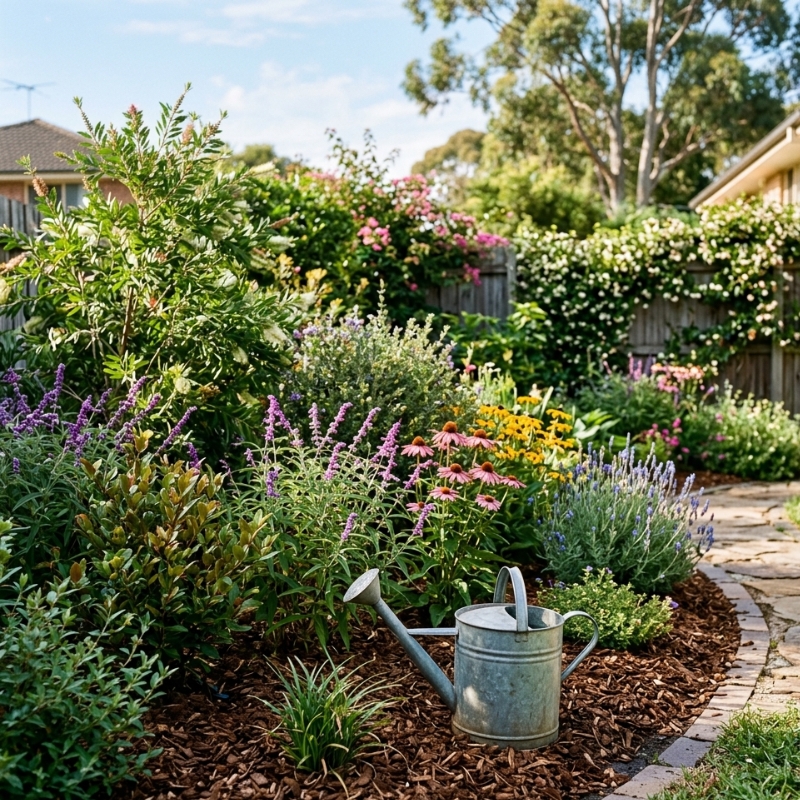
Sydney gardens can go from “lush” to “crispy” fast. One week you’re enjoying steady growth, the next you’re dealing with scorching days, hot westerlies, and soil that looks damp on top but is bone-dry where roots actually live — which is exactly why mulching makes such a difference.
The good news: keeping soil moist is less about watering more often and more about building a simple system that does three things:
• Gets water into the root zone (not just the surface)
• Stops moisture escaping (sun, wind, weeds)
• Helps your soil hold water like a sponge (not shed it like a driveway)
Below is a practical, Sydney-specific guide you can use through summer, windy periods, and those in-between weeks when the weather can’t make up its mind.
Why do Sydney garden beds dry out so quickly
A few local realities make moisture management harder here:
• Hot, dry winds (especially westerlies) can pull moisture out of leaves and soil fast, even if temperatures aren’t extreme
• Strong sun bakes exposed soil surfaces, accelerating evaporation
• Raised beds drain and heat up quicker than in-ground beds
• Soil type extremes are common: some suburbs lean sandy and free-draining, others are heavy clay that cracks and sheds water
• Hydrophobic (water-repellent) soil can appear after dry spells, causing water to bead and run off instead of soaking in
If your watering routine hasn’t changed but plants look stressed, one of these is usually the culprit.
Start with the root-zone rule: surface damp doesn’t count
Most plant roots in garden beds are feeding and drinking well below the top couple of centimetres. If you only wet the surface, you encourage shallow roots, which makes plants more vulnerable to heat and wind.
Aim to wet the soil to a meaningful depth:
• Veggie beds and annuals: roughly 15–25 cm
• Shrubs and perennials: 20–30 cm (sometimes deeper if established)
• New plantings: consistent moisture in the full root ball depth
The 2-minute moisture check (no gadgets required)
Do this before you water, and again an hour after a deep watering:
• Push your finger into the soil (or use a small trowel)
• If the top 5 cm is dry, that’s normal in Sydney heat
• What matters: is it cool and slightly damp at 10–15 cm?
• If it’s dry at depth, you need a deeper soak
• If it’s soggy or smells sour, you may be overdoing it or dealing with drainage issues
A classic sign of “too little, too often” watering is soil that’s damp on top and dusty underneath.
Q&A: How do I know if I’m watering deeply enough?
If you water the bed looks wet, it can still be dry where the roots are. The simplest test is to wait 30–60 minutes after watering, then dig a small hole to 15–20 cm. If that layer is still dry, the water isn’t penetrating deeply enough (or it’s running off, draining away too quickly, or being blocked by compacted soil).
Water timing in Sydney: when it matters most
Timing won’t fix poor soil structure, but it can prevent a lot of wasted water.
Best time to water during heat and wind
In most Sydney summer conditions:
• Early morning watering is usually best (less evaporation, plants start the day hydrated)
• Late afternoon/early evening can work in extreme heat, but avoid leaving foliage wet overnight, especially in humid periods
What to avoid
• Watering in the middle of the day (you lose more to evaporation and wind drift)
• Frequent light watering (encourages shallow roots and faster drying)
• Spraying leaves as a “cool-down” habit (can increase disease risk and doesn’t solve root-zone dryness)
Q&A: Is it better to water every day or water deeply less often?
In most established garden beds, deep watering less often is better than daily light watering. Deep watering builds deeper roots, and deeper roots mean plants handle Sydney’s hot spells and wind better. New plantings are the exception: they may need smaller, more frequent watering until roots extend beyond the original root ball.
Beat evaporation: protect the soil surface like you mean it
Think of bare soil as an open bucket in the sun and wind. Your goal is to put a lid on it.
Use a moisture-preserving cover layer
A protective layer on top of the soil is one of the biggest “easy wins” for moisture. It reduces evaporation, buffers soil temperature, and can reduce weed competition.
If you want a simple next step that fits naturally with this moisture plan, read about mulching for moisture retention and treat it as part of your “hydration system,” not an afterthought.
Groundcovers do more than look pretty
Living groundcovers shade soil, reduce wind at the surface, and improve soil structure over time. Even low-growing plants can make a noticeable difference in exposed beds.
A useful principle is maintaining soil cover to protect moisture and structure, similar to how groundcover is discussed in land and soil management guidance, like this NSW Government resource on groundcover and soil protection.
Q&A: How thick should a protective layer be?
It depends on the material and what you’re trying to achieve, but the key is consistency: an even layer that covers soil completely without piling up against plant stems. If parts of the bed are bare, evaporation will find them.
Fix water-repellent (hydrophobic) soil: when water beads and runs off
If water sits on top, beads up, or runs to the lowest point, your bed can be both “watered” and still thirsty.
Hydrophobic soil can happen after prolonged dryness, especially in sandy soils, potting mixes that have dried out, or beds with certain organic residues.
Signs you’re dealing with hydrophobic soil
• Water pools on the surface instead of soaking in
• The top looks wet, but beneath is dry and dusty
• Water runs down cracks or pathways and misses the root zone
• You can’t re-wet the bed without repeated watering
Practical ways to re-wet it
Try these in order (often a combination works best):
• Slow the water down: use a hose on a trickle, a soaker hose, or drip irrigation
• Water in cycles: water briefly, wait 10–20 minutes, water again (helps break surface tension)
• Lightly cultivate the surface: gently rake 2–5 cm deep to open pathways (avoid damaging roots)
• Add organic matter over time: compost and conditioners improve structure and water-holding
• Consider a soil wetter/wetting agent: useful as a short-term bridge in stubborn cases
Once you get water soaking in properly again, keeping the soil covered and improving the structure will reduce the chance of it returning.
Q&A: Why does my soil look wet, but plants still wilt?
Because plants drink from the root zone, not the surface. In hydrophobic or compacted soils, water can sit on top, run off, or channel through cracks, leaving most roots dry. Wilting in hot wind can also be a transpiration issue (plants losing water through leaves faster than roots can replace it), so you need both deep moisture and wind protection.
Make your soil hold water longer (without turning it into mud)
Sydney gardens often sit at extremes: either free-draining sandy soil that won’t hold moisture, or heavy clay that holds water but can become hard, cracked, and difficult to re-wet.
The sweet spot is stable soil structure: crumbs and pores that absorb water, store it, then release it slowly.
For sandy or coastal-leaning soils
Goal: increase the soil’s “sponge” capacity.
• Add compost regularly (small amounts, often)
• Use well-aged organic matter (avoid hot/unfinished material)
• Consider incorporating water-holding amendments suited to garden beds
• Keep the surface covered year-round to reduce evaporation
For clay soils
Goal: improve infiltration and prevent crusting/cracking.
• Add compost to improve structure (not just sand, which can backfire)
• Avoid working clay when it’s very wet (compaction risk)
• Water slowly so moisture can soak in rather than run off
• Keep soil covered to reduce surface baking and cracking
Q&A: Should I add sand to clay soil to improve drainage?
Usually, compost and organic matter are the safer long-term approach for improving clay structure. Adding sand to clay can sometimes create a concrete-like mix if the ratios and particle sizes aren’t right. If your clay is severe and you’re unsure, focus on building organic matter and protecting the surface first.
Wind is a moisture thief: protect plants and beds from hot westerlies
Wind doesn’t just dry out soil; it increases plant water loss through leaves. That’s why a bed can be “adequately watered” yet still look stressed on a windy, hot day.
Ways to reduce wind impact
• Use temporary shade cloth on extreme days (especially for new plantings)
• Add wind-filtering plants (not solid walls of foliage, which can create turbulence)
• Position taller plants to shelter more tender ones
• Prioritise deep watering before a forecast hot, windy day
• Avoid heavy pruning right before heat or wind events (it can expose plants)
Heatwave plan for Sydney gardens (simple and effective)
The day before or early morning of a hot spell:
• Deep water the root zone
• Check for dry “missed zones” (corners, raised edges, under dense foliage)
• Top up your protective surface layer where it has thinned
• Move potted plants to morning sun/afternoon shade where possible
• Delay fertilising until cooler weather (it can stress plants in heat)
Q&A: My plants wilt in the afternoon but recover at night. Do they need more water?
Not always. Some plants “flag” in heat as a protective response. If they recover overnight and the soil is moist at 10–15 cm, they may be coping. If they don’t recover, or the soil is dry at depth, you likely need deeper watering or better moisture retention.
Irrigation that actually helps (and doesn’t waste water)
If you want consistent moisture through summer and wind, the best irrigation is the one that applies water slowly and evenly into the root zone.
Drip irrigation and soaker hoses: the moisture-friendly option
They:
• Reduce evaporation compared to overhead watering
• Deliver water closer to roots
• Work well with deep watering schedules
• Minimise leaf wetness (often better for plant health)
Overhead sprinklers: when they can work
They’re not “wrong,” but they’re easier to waste water with in windy weather. If you use them:
• Water early morning
• Use larger droplet / lower mist settings if possible
• Check coverage (wind shadows and overspray are common)
Q&A: Do raised beds need different watering?
Yes. Raised beds typically drain faster and warm up quicker, so they often need:
• Slower watering for longer (to fully wet the profile)
• Better soil blends with added organic matter
• Consistent surface protection to reduce evaporation
• Extra attention to edges and corners, which dry first
Put it all together: a simple weekly moisture routine
Here’s a practical routine you can run through Sydney’s warmer months.
Twice weekly (or as needed in hot spells)
• Do the 2-minute moisture check
• Deep water if dry at 10–15 cm
• Water slowly enough to soak in, not run off
• Spot-check corners, raised edges, and exposed areas
Weekly
• Pull weeds before they establish (weeds are moisture competitors)
• Break any surface crust lightly (where safe) to improve infiltration
• Inspect your surface cover layer and top up thin patches
• Check irrigation for blocked emitters or uneven coverage
If you want a clear guide to the “cover layer” part of this system, knowing how to mulch garden beds properly as your reference point, then keep everything else (watering depth, soil structure, wind protection) working around it.
Common mistakes that cause dry beds (even when you water)
If your beds keep drying out, one of these is usually in play:
• Watering too fast (runoff)
• Watering too shallow (surface wet, root zone dry)
• Bare soil exposure (evaporation wins)
• Hydrophobic soil (water can’t penetrate)
• Compacted soil (water can’t infiltrate)
• Wind exposure (plants lose water faster than roots can supply it)
• Over-fertilising in heat (adds stress and increases water demand)
Q&A: What’s the fastest “fix” I can do this week?
The quickest improvements usually come from:
• Switching to slower, deeper watering
• Covering exposed soil consistently
• Breaking the cycle of hydrophobic runoff with soak-and-wait watering
• Checking moisture at depth before adding more water
For many Sydney beds, the most noticeable change comes when you combine deep watering with mulch layers that reduce evaporation so the moisture you add doesn’t disappear the next day.
FAQ: Soil moisture in Sydney gardens
How often should I water garden beds in Sydney’s summer?
There’s no one-size schedule because wind, sun, soil type, and plant density change everything. A better approach is to check moisture at 10–15 cm and water deeply when that layer is drying out. During heatwaves or hot, windy periods, beds may need deeper watering more frequently.
What’s the best time to water during hot weather?
Early morning is usually best in Sydney: less evaporation and plants start the day hydrated. Late afternoon can help in extreme heat, but avoid consistently wet foliage overnight.
Why does water run off my garden bed?
Common reasons are hydrophobic soil, compaction, or dry cracked clay that channels water away from roots. Slow watering, watering in cycles, gentle surface cultivation, and building organic matter help restore infiltration.
Do I need to water more on windy days?
Often yes, but the best “wind strategy” is deep moisture plus wind reduction. Hot winds can cause plants to lose water rapidly through their leaves. Deep watering ahead of the wind event and protecting the soil surface make a bigger difference than just spraying more often.
How can I keep soil moist without overwatering?
Check moisture at depth before watering, water slowly so it penetrates, and focus on reducing evaporation with full soil cover and healthy soil structure. Moist soil should feel cool and slightly damp, not waterlogged.
My soil is damp, but plants still look stressed. Why?
It could be shallow watering (root zone dry), wind-driven leaf water loss, hydrophobic soil preventing water penetration, or roots struggling due to compaction or heat stress. Check moisture at depth and look for runoff or pooling.
Are pots and planters different?
Yes. Containers heat up and dry out faster than in-ground beds. They usually need more frequent watering, better potting mix structure, and protection from harsh afternoon sun and wind.

