
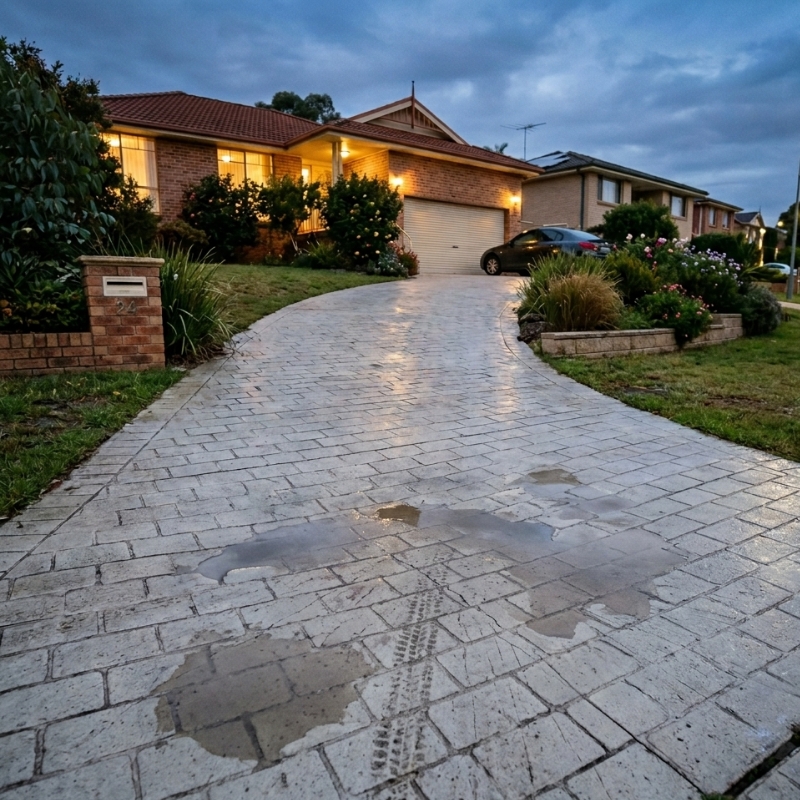
A tidy driveway makes the whole front yard look cared-for, yet Sydney homeowners often miss the first hints that their pavers are starting to fail. Because those clues appear gradually, it is easy to shrug off a small divot, a faint line or a slightly wobbly edge. By the time the damage is obvious, remediation can involve lifting and relaying sizeable sections or even rebuilding the base. Identifying subtle changes early is the simplest way to protect your investment and avoid safety hazards. In this guide, we look at the eight most common early warning signs, why they happen in Sydney’s climate and soil, and what you can do next. If you spot any of the issues below and need tailored advice or repairs, our team can help with professional paving services.
1. Why Catching Paver Problems Early Saves Money
Small failures in paving act like doorways for larger ones. A loose joint lets more water under the surface. Water weakens the base, causing a dip. The dip collects more water, surrounding pavers shift, and before long the damage circles outward like ripples in a pond. Fixing one low corner might cost a few bags of bedding sand and an hour of labour. Fixing a driveway-wide hollow could mean excavators, tonnes of new road base, and a disposal fee at the tip. Early detection also avoids trip hazards, vehicle damage and council infringement notices if debris spills onto the footpath.
Sydney’s mixed geology and rainfall patterns magnify these risks. Western suburbs with clay-rich soils are prone to seasonal heave and shrinkage, while coastal zones deal with salty air eroding sealants. Spotting minor defects in these conditions matters even more, especially if your driveway fronts the street where water from passing storms can flow across the pavers.
2. Local Factors That Stress Driveway Pavers in Sydney
Before looking for specific signs, it helps to understand what pushes pavers past their limit around the Harbour City.
Thermal swings
Sydney’s summers regularly nudge 35 °C, yet winter nights, especially in outer suburbs, can drop below 5 °C. That expansion–contraction cycle causes micro-movements between pavers and within the bedding layer.
Sudden downpours
Short, intense storms dump water faster than many suburban drains can handle. When water pools on a driveway or rushes across it, fines in the bedding layer can erode and create voids.
Clay pockets
Many Sydney blocks sit on reactive clay. When dry, clay shrinks; when wet, it swells. The ground literally rises and falls, lifting some pavers and dropping others.
Tree roots
Jacarandas, paperbarks and bottlebrushes are driveway favourites, but their roots thicken over time, prising pavers upward or robbing the sub-base of moisture and stability.
Coastal air
Salt carried on onshore winds can break down certain sealers faster than expected, leaving paver surfaces porous and prone to staining and algae growth that hide cracks.
Understanding these local pressures makes the early signs below easier to spot.
3. Fine Surface Cracks or Hairlines
Hairline cracks in concrete or manufactured stone pavers often appear first. They look cosmetic but signal either thermal stress, minor movement underneath, or both. In Sydney’s sun, the top layer can dry faster than the base, shrinking slightly and opening a line barely wider than a credit-card edge. Catch it early, clean out the dust, apply a breathable sealant and monitor. If you wait until the crack widens enough to catch a fingernail, moisture will already be working on the bedding below.
4. Drummy or Hollow Sounds Underfoot
Tap a paver with the handle of a screwdriver. A solid “thunk” means the paver is fully bedded. A hollow “drum” suggests a gap between the paver and the compacted base. Those voids often stem from lost bedding sand after heavy rain or from ants tunnelling. They rarely fill themselves and instead grow as traffic and water pump more fines away. Mark the spot and recheck in a month; if the hollow area expands, re-bedding that section soon is cheaper than waiting for a crater.
5. Early Water Behaviour Red Flags
Water tells the truth about hard surfaces. After rain, stroll outside and watch how it behaves:
• Puddles that linger in a single spot hint at a localised dip.
• A trickle that consistently veers left or right suggests uneven gradients.
• Damp patches that remain long after nearby areas dry could signal a blocked edge drain, letting water soak back under pavers.
Because Sydney sees bursts of rain followed by strong sun, repeated wet-dry cycles quickly weaken jointing sand and encourage algae. Level corrections or improved drainage channels are fast fixes when done early.
6. Minor Edge Migration
Driveway edges without a proper concrete haunch or soldier course can creep outward over time. You might notice a small outward lean or joint gaps opening on the border row. Vehicle tyres rolling near the edge amplify the movement, and before long the pattern migrates across the drive. For homeowners wondering whether installing driveway pavers is worth the investment, maintaining structural elements such as a cement haunch is essential for preserving the driveway’s durability and performance. Installing or repairing a cement haunch promptly contains the rest of the field.
7. Comparing Minor vs Serious Signs at a Glance
The table below sums up early clues, what they might mean and an appropriate first step.
| Sign | What It May Indicate | Suggested Action |
| Hairline surface crack | Thermal stress or minor base movement | Clean, seal, monitor 4–6 weeks |
| Hollow sound when tapped | Lost bedding sand or small void | Lift and re-bed affected paver |
| Small, persistent puddle | Localised dip, poor drainage | Adjust levels or add drainage strip |
| Edge pavers leaning outwards | Missing/failed haunch | Reinstate edge restraint |
| Joint sand disappearing | Excessive wash-out, ants | Top up with matching joint sand and seal |
| Slight height difference at the expansion joint | Sub-base shrinkage or heave | Check sub-base compaction, re-screed small area |
| Fine moss line between pavers | Constant moisture presence | Improve runoff, clean and seal |
| Tyre rut beginning to show | Base compaction failure | Inspect and strengthen base before driving causes more subsidence |
A single minor sign rarely warrants a full rebuild, but several appearing together point to systemic issues that need assessment.
8. DIY Monitoring or Professional Assessment?
While most homeowners can lift a loose paver, resetting it on a compromised base only masks the problem. Use the checklist below to decide when to call in help.
Safe to DIY Monitor
• Surface cracks narrower than 2 mm
• Single loose paver under foot traffic only
• Joint sand erosion confined to one corner
Consider Professional Assessment
• Cracks widening over weeks
• Visible rut after vehicle use
• Multiple hollows that keep returning
• Edging movement greater than 5 mm
• Drainage issues joining with subsidence
A qualified installer will run simple levels, probe the bedding and advise whether the sub-base meets the tolerances outlined in the NSW Guide to Standards and Tolerances.
9. Mistakes Homeowners Make When Investigating Paver Problems
- Patching joints with building sand
– Building sand stays damp and washes away quickly. Use kiln-dried paving sand instead.
- Ignoring ants
– Anthills indicate sand removal. Treat nests and refill joints.
- Washing with high-pressure wands too close to joints
– A powerful jet strips joint sand and opens paths for water.
- Relaying without fixing drainage
– Resetting pavers on the same wet base guarantees the issue returns.
- Sealing over damp surfaces
– Moisture trapped under the sealer turns into white haze or blistering.
Avoiding these missteps preserves the life of the repair.
10. Helpful Questions to Clarify Before Taking Action
• Has the driveway been professionally sealed within the last three years?
• Where does water exit during heavy rain—street gutter, garden, garage?
• Are there large trees within three metres of the slab edge?
• Was the driveway base compacted in layers or poured at once?
• Is there any history of utility trenching under the drive?
Discussing these questions with an installer will speed up diagnosis and prevent unnecessary work.
11. Want to Learn More About Paver Damage?
If you are unsure whether those hairline cracks need urgent attention, take a deeper dive into what’s normal and what needs fixing when paver cracks appear. It explains crack types in detail and helps you decide whether sealing, relaying or replacing is the logical next step.
Frequently Asked Questions
1. How often should I inspect my driveway for early warning signs?
A quick visual check every two or three months is usually enough. Add an extra inspection after extreme weather, such as a summer deluge or an extended dry spell, because Sydney’s soil moves most at those times.
2. Can I fill small cracks with grout or concrete caulk?
Thin, flexible crack sealants can buy time, but rigid grout or concrete caulk often pops out once the slab moves again. Flexible, UV-stable compounds are safer for hairlines, while wider cracks need the underlying base fixed first.
3. Do permeable pavers eliminate the risk of sinking?
They can reduce water pooling, but they still rely on a stable, well-prepared base. In clay soils or under heavy vehicles, permeable systems need the same compaction standards as traditional pavers.
4. What causes tyre ruts even when the base seems thick enough?
Repeated point loads from turning wheels, especially on hot days, can shear the bedding layer. If fines migrate or moisture weakens the base, rutting follows. Strengthening that layer and adjusting turning areas can help.
5. Is resealing worth it if my driveway looks fine?
Yes. A quality sealer protects against UV fade, oil stains and water ingress. In Sydney’s climate, resealing every three to five years prevents the micro-damage that eventually leads to the bigger issues discussed above.
Final Thoughts
Spotting and fixing driveway paving issues while they are still small is the cheapest form of maintenance. Sydney’s shifting soils, storm bursts and summer heat all conspire to widen cracks, hollow bedding and dislodge edges. A few minutes’ inspection after rain, or when washing the car, can alert you to problems long before they demand heavy equipment and a large outlay. If you do notice recurring hollows, widening cracks or stubborn puddles, seeking timely professional advice is usually more economical than waiting for a full driveway rebuild.
)
&description=&image=https://a1gardeningsydney.com.au/wp-content/uploads/2026/06/Early-Warning-Signs-Your-Driveway-Pavers-Need-Attention-Before-Small-Issues-Turn-Costly.jpg)