
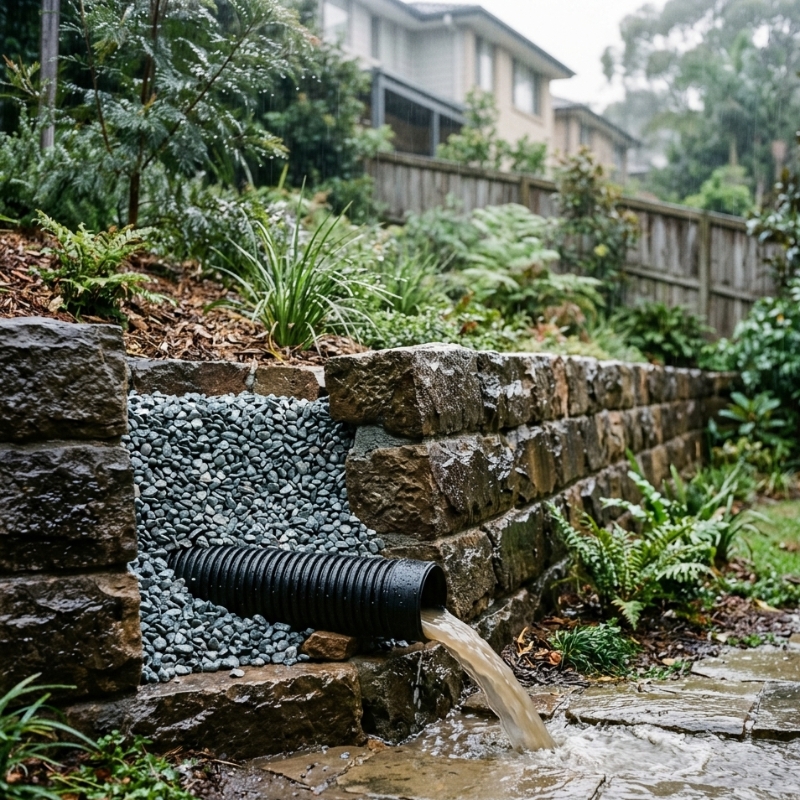
A retaining wall that looks rock-solid today can fail quickly once water builds up behind it. Sydney’s clay pockets, sudden summer storms and unpredictable downpours mean drainage is your wall’s first line of defence, not an optional extra. If the backfill can’t release excess moisture, hydrostatic pressure pushes on every block, sleeper or poured-concrete panel. Left alone, that pressure can bow a wall, crack mortar joints or send pavers and garden beds sliding downhill.
Plenty of homeowners ask whether a quick weekend job—unblocking a weep hole or rerouting a downpipe—will solve the problem. Sometimes it can. Other times, only a licensed contractor with proper excavation equipment and engineering know-how can stop a slow lean from turning into a safety hazard. This guide walks you through the warning signs, the simpler fixes you can handle yourself, and the situations that call for professional retaining-wall help instead.
1. Why Drainage Matters Behind Every Retaining Wall
Water trapped behind a retaining wall increases soil weight dramatically. Just 10 cm of saturated soil can add hundreds of kilos of sideways force. In Sydney, rainfall patterns switch from long dry spells to intense bursts, so soil expands and contracts more than in many parts of Australia. Clay belts in suburbs like Penrith, Baulkham Hills and parts of the North Shore are especially reactive, making proper drainage even more important.
Good wall design usually includes:
• Free-draining backfill such as clean 20 mm gravel
• An agricultural (ag) pipe wrapped in geotextile fabric
• Weep holes spaced at roughly 1.2–1.5 m centres
• Waterproofing or drainage board on the wall’s rear face
• A graded surface so runoff doesn’t pour straight over the top
If any of these elements are missing, clogged or damaged, water starts collecting. The longer it stays, the higher the pressure.
2. How to Spot Drainage Problems Early
You rarely see water pushing on a wall until damage has begun, but subtle clues appear first.
| Early Sign | What It May Warn You About | Immediate Action |
| Damp patches or efflorescence (white salts) on wall face | Moisture migrating through blocks or sleepers | Monitor after rain and clear nearby weep holes |
| Soil washed out at the wall base | Water escaping through cracks instead of drainage line | Replace lost soil and inspect for hidden voids |
| Small horizontal or diagonal cracks | Wall movement from uneven loading | Photograph the cracks and recheck size monthly |
| Bulging in the centre of a panel or sleeper row | Hydrostatic pressure building | Reduce surface water; plan professional inspection |
| Pooling water at toe (bottom) of wall | Blocked or missing ag pipe outlet | Locate outlet, clear debris, assess pipe condition |
If two or more symptoms appear together, treat the situation as urgent.
3. Safe DIY Checks and Minor Fixes Homeowners Can Attempt
Not every drainage hiccup needs machinery and structural rebuilds. Before calling in the big guns, Sydney homeowners can usually handle these safer tasks:
- Clear visible weep holes
• Use a stiff wire or narrow screwdriver to dislodge dirt and leaf litter.
• Flush with a hose to confirm water drains freely.
- Locate the ag-pipe outlet
• Outlets often discharge into a garden bed or stormwater pit.
• Trim vegetation and remove blockages so water runs out unimpeded.
- Redirect downpipes and garden taps
• Fit a flexible extender to downpipes that empty too close to the wall.
• Check automatic irrigation heads aren’t spraying directly on backfill.
- Improve surface grading
• Use a rake and shovel to create a gentle slope away from the wall crown.
• Avoid piling new soil or mulch against the wall without matching drainage.
- Top up gravel where it has settled
• Remove any fine sediment first.
• Refill with clean drainage gravel, not road base or soil.
These jobs typically cost little more than time, a bag of gravel and basic hand tools. If improvements appear within a few weeks—wall face dries sooner, no more puddles—your DIY effort may be enough.
4. Where DIY Often Goes Wrong: Mistakes That Increase Wall Failure Risk
Even well-meaning weekend work can trigger bigger problems if you’re not careful:
• Sealing weep holes with silicone or paint “to keep pests out”, which blocks drainage.
• Replacing free-draining gravel with soil because “it looks neater”, trapping water.
• Lining the back of a timber wall with plastic sheeting but forgetting a drainage layer, so water pools behind the liner.
• Cutting tree roots without checking if they stabilise the bank, leading to sudden slumping.
• Installing patio paving above the wall without adding expansion joints or sub-surface drains, forcing runoff straight down the rear face.
If you’ve already done one of these and notice fresh cracking or bulging, undo the change quickly and monitor the wall. Continued movement is a sign to call in an expert.
5. When Professional Assessment Becomes the Safer Option
Height, load and soil type govern whether a wall is DIY-friendly or demands licensed help. In many council areas, walls over 600 mm high or supporting a driveway, pool or building footings legally require engineering sign-off. Beyond the rules, the practical risk jumps once structural movement is visible.
| Scenario | Risk Level | Recommended Next Step |
| Wall higher than 1 m or tiered walls stacked together | High | Structural engineer design and licensed contractor build |
| Lean measuring over 10 mm per 1 m of height | High | Urgent engineering assessment; temporary bracing may be needed |
| Repeated crack widening after heavy rain | Medium | Drainage and soil investigation by retaining-wall specialist |
| Ag pipe discovered to be crushed or missing | Medium | Professional excavation to replace pipe and inspect wall footing |
| Minor seepage but wall supports a patio or driveway | Low–Medium | CCTV drain inspection and possible backfill refresh |
In short: if a wall moves, holds up a structure or exceeds local exempt-development heights, professional input is the smart (and often required) path.
6. Understanding Sydney’s Soil and Rainfall Patterns
Sydney’s sandstone ridges shed water quickly, but its lower-lying clay valleys hold moisture for days. Stormwater runoff from summer thunderstorms can dump 20–30 mm of rain in under an hour, loading backs of walls before ag pipes catch up. Coastal suburbs face salt-laden air that corrodes galvanised drain fittings faster, while hills districts see more expansion and contraction of clay.
The NSW Planning Portal confirms that drainage must safely discharge to a lawful point, not a neighbour’s yard or the street gutter without approval. Check the NSW Planning guidance for latest compliance notes before altering existing drainage lines.
7. Council Rules and Underground Services: Don’t Dig Blind
Before grabbing a shovel:
• Dial 1100 “Before You Dig” to map gas, water and telecom services—ag pipes often run just above them.
• Check whether your local council treats retaining-wall drainage work as “minor landscaping” or as structural modification needing development consent.
• Obtain neighbour agreement if the wall sits on or near a boundary, especially if your drainage line will exit onto shared land.
• Keep excavation spoil at least 500 mm from the trench edge to avoid sudden collapses in Sydney’s softer soils.
Ignoring these basics risks fines, burst pipes and expensive rectification notices.
8. Comparing DIY Drainage Add-Ons vs Full Professional Rebuild
A side-by-side snapshot helps clarify which route makes sense for your yard.
| Aspect | DIY Add-Ons (e.g., clear weep holes, surface regrade) | Professional Drainage Retrofit | Full Wall Rebuild |
| Typical Scope | Minor surface work, no structural changes | Excavate rear, install new ag pipe, geofabric and gravel | Demolish, new footing, new wall, full drainage system |
| Disruption | Low | Moderate—partial excavation | High—heavy machinery, multiple days |
| Equipment Needed | Hose, shovel, hand tools | Mini-excavator, compactor, laser level | Excavator, engineering supervision, compactor, crane if concrete blocks |
| Expected Lifespan Gain | Months to a few years | 5–15 years (depends on wall age) | 25 + years |
| Council Approval Likely? | Rarely | Sometimes (if outlet changes location) | Usually required |
| Warranty | None | Contractor workmanship warranty | Structural and workmanship warranties |
Use the table as a decision filter: if your symptoms sit in the middle column but the wall is still structurally sound, a drainage retrofit may be the sweet spot.
9. Questions That Help You Understand the Repair Approach
Asking the right questions reveals whether a contractor’s plan suits your wall’s real problem:
- “How will you confirm the existing footing depth and condition?”
- “What size and fall will the new ag pipe have?”
- “Will you wrap the drainage gravel in geofabric to stop silt clogging?”
- “How will you protect nearby tree roots or underground services?”
- “What warranty do you provide on drainage work versus wall stability?”
Clear, confident answers signal a contractor who understands the wall’s structure, Sydney’s varied soil behaviour, and when a retaining wall is needed for your landscaping.
FAQs
1. Can I just drill extra weep holes in an existing block wall?
Drilling additional holes may seem an easy fix, but you can weaken mortar joints or reinforcing steel if you pick the wrong spot. Extra outlets also won’t help if the backfill is clay or the ag pipe is blocked. A licensed professional should assess whether more weep holes will genuinely relieve pressure without compromising strength.
2. What diameter ag pipe is best for a residential retaining wall in Sydney?
Most domestic walls use 65 mm to 100 mm slotted PVC ag pipe. The choice depends on wall height, catchment area and expected runoff. A wider pipe handles sudden downpours better but needs sufficient fall to drain properly. A contractor will calculate size after checking site levels.
3. How often should I flush the ag pipe behind my wall?
If your outlet is accessible, back-flush with a hose at least once a year—ideally after autumn leaf drop. In areas with clay, silt can collect faster, so a six-month schedule is safer. If the water runs cloudy or backs up quickly, arrange a CCTV inspection.
4. Does waterproofing the wall face stop drainage problems?
Waterproof membranes keep moisture from penetrating wall blocks, but they don’t remove water. Membranes should work with, not replace, gravel backfill and ag drains. Without an escape path, water will still build pressure and may seep under the footing instead.
5. Are retaining-wall failures covered by home insurance?
Policies vary. Insurers often exclude gradual earth movement but may cover sudden collapse due to a storm event. They’ll usually ask for evidence of regular maintenance and compliant construction. Document your DIY checks and any professional reports to strengthen a claim.
Final Thoughts
A healthy retaining wall in Sydney needs more than strong blocks and neat capping—it needs an escape route for the constant moisture our climate delivers. Simple DIY tasks such as clearing weep holes, redirecting downpipes and topping up gravel can prevent many issues. Yet once you see cracks widening, bulges forming or the wall passing legal height limits, specialised help is the safer call. Understanding where that line sits, and how local soil and rainfall shape your decision, keeps your garden walls functional and your landscape investment secure for decades to come.

